
By Benj Edwards for Fast Company
Nolan Bushnell is Exclusively Represented by CAL Entertainment
In the annals of Silicon Valley history, Nolan Bushnell’s name conjures up both brilliant success and spectacular failure. His two landmark achievements were founding Atari in 1972–laying the groundwork for the entire video game industry–and starting Chuck E. Cheese’s Pizza Time Theatre in 1977. But there’s another highlight of Bushnell’s bio that has long gone undocumented: pioneer of the high-tech incubator.
In 1981, Bushnell created Catalyst Technologies, a venture-capital partnership designed to bring the future to life by turning his ideas into companies. In the era of the TRS-80, Betamax, and CB radio, startups funded by Catalyst pursued an array of visionary concepts–from interactive TV to online shopping to door-to-door navigation–that created entire industries decades later. “I read science fiction, and I wanted to live there,” Bushnell explains.
His incubator only existed for half a decade, and most of the tech startups that emerged from it are long forgotten. “You might say he flew too high and his wings burned off,” says Alan Alcorn, a longtime collaborator of Bushnell and the developer of Atari’s Pong.
Catalyst’s mostly forgotten story serves both as a reminder of the daring nature of entrepreneurship and as a cautionary tale for those who might try to do too much, too quickly. And for Bushnell, the memories remain satisfying. “It was actually a fun project for me,” he says. “I enjoyed it a lot.”
BUSHNELL IN A NUTSHELL
As a kid growing up in Clearfield, Utah, Nolan Bushnell would visit a local boneyard where he scoured the hulking bellies of rusty aircraft looking for spare parts. “They were melting down airplane fuselages from World War II for the aluminum,” he recalls. “Inside the airplanes, they still had the radios, wiring, and lights in them, and we’d sneak down at night and strip them out.” It was a hazardous place for a kid, but it was also a wonderland.
Around the same time, he built a small cinder block building in his backyard so he could blow stuff up safely. He was not afraid of taking risks to learn new things, and as he grew older, he also found that he was not afraid of using his personal charm and charisma to get what he wanted.
During a summer job while in college, Bushnell occupied his restless mind’s spare hours by working at a local theme park. His superiors quickly promoted him to manage the entire midway, which included an arcade and a typical array of carnival games. He learned about what it took to attract customers and keep them coming back for more–two lessons that would define the course of his life.
In 1969, Bushnell relocated to Silicon Valley to work at recorded-media pioneer Ampex. In 1970, with the help of a fellow engineer named Ted Dabney, he hatched the blueprint for the commercial video game industry by designing Computer Space–the first commercial video game ever launched. It was not a knockout success. But the following year, Bushnell and Dabney cofounded Atari.
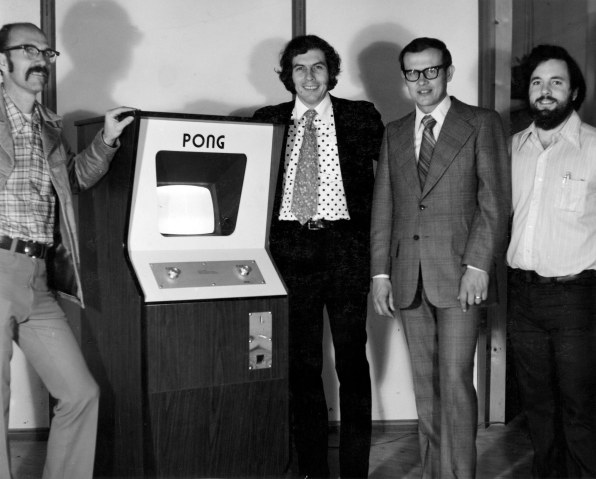
When their new startup launched an arcade game called Pong in the fall of 1972, it set the arcade industry on fire. Several other hit arcade games followed, then Home Pong in 1975. Soon, Atari was at work on a next-generation game console with removable cartridges, designed to leapfrog the oversaturated dedicated home console market.
Atari had been largely self-funded at that point. Despite the popularity of its games, it had skirted with bankruptcy. But now it needed capital to develop its new console, so Bushnell sought a buyer. In 1976, the Warner Communications media empire–the predecessor of today’s Time Warner–acquired Atari.
After the Warner acquisition, Atari’s ambitious CEO had trouble focusing on the intricacies of the video game business. His newfound wealth—about $15 million of the proceeds of the merger–served as a compelling distraction. Recently divorced, he sailed yachts, traveled the world, and even bought a 14,000-square-foot mansion in Woodside, California.
But he was still hungry to create new things. At the time, there were no personal robots, no high-definition TV sets, no video phones. If he wanted to see them come to pass, he realized he would have to make them happen himself.
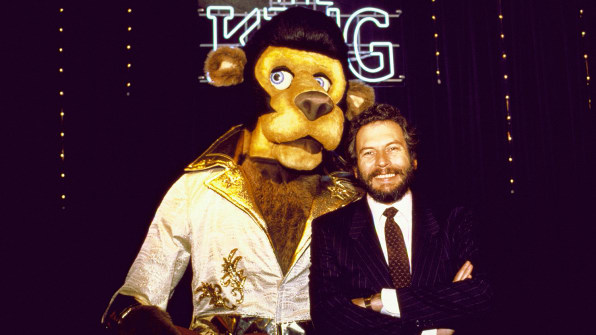
At first, Bushnell dabbled in the future at Atari. Pizza Time Theatre, the kernel that would become the Chuck E. Cheese chain of family arcade restaurants, began as an Atari division in 1977, and it became Bushnell’s pet project. Its animatronic signing robots were cutting-edge for the time. Bushnell also encouraged Atari’s engineers to experiment with futuristic technologies outside the realm of video games, such as video phones (a project called “Phoney”), computerized cameras, and telecommunications devices for the deaf.
But Bushnell’s overlords at Warner weren’t amused–especially by the singing robots. They didn’t want to be in the pizza business. To keep his dream alive, Bushnell acquired Pizza Time from Atari in 1978 while still working there. After a showdown with Warner management over the future of the then poor-selling Atari VCS console–which Bushnell wanted to ditch and replace with a more advanced system–Warner forced Bushnell out of the firm in November 1978. He was 35 years old.
CATALYST IS BORN
Around the time of his Atari departure, an important future collaborator entered Bushnell’s life. “I got a call from Nolan, and he was in the throes of getting terminated by Warner Bros,” says Larry Calof, a lawyer based in Los Angeles at the time. “I ended up negotiating Nolan’s termination package from Atari. That’s how he and I got to know each other.”
In many ways, Bushnell says, leaving Atari was liberating. Once free of the company, he could pursue any path he wanted. And with an epoch-shifting success like Atari under his belt, he was wildly optimistic. “I was a young man and I had worlds to conquer,” he says today. “I think I was kind of arrogant. I really felt that I had the Midas touch.”
In 1979, Bushnell ran into trouble with the Pizza Time chain and called in a new management team to help. As those executives steered the company, Bushnell began to step away from duties there and turned his attention toward new opportunities. He had so many ideas–and so many talented friends and colleagues that could implement them. But he saw a daunting task ahead of him if he wanted to do something about it: Starting a company from scratch for each and every idea would take a lot of work.
One of the biggest problems with startups, Bushnell realized, is the sheer amount of “bullshit housekeeping stuff” involved. One needs to acquire funding, find a building, buy furniture, sign contracts, get lawyers, hire management, and handle payroll, among other administrative tasks.
To Bushnell, all that got in the way of the core reason for the business: the technology. He devised a plan to start creating small businesses as fast as possible. Each one would be an investment vehicle for Bushnell’s fortune while simultaneously accelerating the future’s arrival.
Central to this idea would be a shared office space–a command center where Bushnell and his lieutenants would be able to guide the proceedings. “My idea was that I would fund [the businesses] with a key,” says Bushnell. “And the key would fit a lock in a building. In the building would be a desk and chair, and down the hall would be a Xerox machine. They would sign their name 35 times and the company would be incorporated.” All the details would be handled: “They’d have a health care plan, their payroll system would be in place, and the books would be set up. So in 15 minutes, they would be in business working on the project.”
And once these microfirms were up and running, the fledglings could leave the nest and set out on their own–by getting acquired or by becoming thriving standalone businesses.
What Bushnell had just devised was an incubator. It wasn’t the world’s first such company, but it was very likely the first in Silicon Valley, and it was the first to focus on the high-tech world that spawned from the 1970s revolution in semiconductor technology.
Bushnell invited Calof, his longtime lawyer, to help develop the idea. Then he brought in John Anderson, the former CFO of Atari, to handle the financial side. In 1981, the three of them decided to call their new investment partnership Catalyst Technologies–with their money being the “catalyst,” so to speak, of tech innovations.
They raised a venture fund, soliciting investment from others in the area, and planned to match the venture fund’s interest in each company personally, although Bushnell ended up shouldering most of the financial burden.
The group leased a building on Lawrence Station Road in Sunnyvale, California–the former headquarters of Dysan, a manufacturer of floppy disks. “It was a wonderful old thing that everybody called the ‘Rust Bucket’ because it was made out of steel that rusts and protects itself,” recalls Bushnell. The building was ideal because it had several bays that could be used for different companies. And at over 48,000 square feet, it provided lots of room–at one point, over 14 companies shared its interior, although the larger, more successful firms soon moved out and into their own spaces.
In 1982, the Catalyst founders rounded out the team with Perry Odak, the former VP of consumer products at Atari. Between the four of them, Calof says, Bushnell had a lawyer, an accountant, a business guy, and an idea man. And Catalyst was always intended to be a skeleton crew: At its peak, its core staff numbered only seven or eight people. Calof was named president and Bushnell was named CEO.
When it came time to decide which projects to pursue, the team shunned unsolicited pitches. Instead, the ideas mostly came from Bushnell or his associates. With the constellation of talent Bushnell knew around the valley, the project took off quickly. Within the first year, Catalyst was funding 10 separate technology firms. Soon that roster grew to 14, then between 17 and 20 at its peak. (It’s hard to pin down the exact number because some of the “companies” existed only briefly as research projects, and some of Bushnell’s other investments were often counted as Catalyst firms by association.)
Many of these microcompanies featured Bushnell as chief investor and chairman of the board, and several were staffed with Atari alumni such as Alan Alcorn, who spearheaded the technology behind a video game distribution company called Cumma. Joe Keenan and Gene Lipkin, both Atari veterans, also joined the effort. Such choices, which rewarded loyalty as much as skill, weren’t always perfect fits. But Bushnell’s charismatic nature had a way of roping in those around him to help him achieve his goals. Alcorn in particular served as a trusted sounding board for many of Bushnell’s ideas.
THE FUTURE, TOO SOON
Aside from a familiar crew of Bushnell cronies, most of the Catalyst companies had another thing in common: They were almost unnaturally ahead of their time.
For example, a firm named Cinemavision pursued high-definition television and digital theater projection in the early 1980s. ACTV invented an interactive cable TV system for choosing camera angles for live broadcasts or playing quiz shows. ByVideo dealt with an early form of semi-online shopping: Users browsed items on a screen at a kiosk, served up by LaserDisc, and the machine reported purchases back to a central shipping warehouse via modem. Alcorn’s Cumma allowed electronic distribution of video games through rewritable cartridges programmed by special vending machines.
Each of these firms represented kernels of ideas that would become successful decades later, in the hands of firms like Sony, Texas Instruments, Time Warner, Amazon, and Valve. But one huge thing was missing: the technology infrastructure to make them practical in the early 1980s.
“A lot of these things were so far ahead of their time that either there wasn’t the market, or the technology wasn’t there to take it to the step where it could be commercialized,” says Calof. “For example, we were doing HDTV before HDTV really could be HDTV. We had an essence of a video phone working before you could do that with the technology that was available 15 years later.”
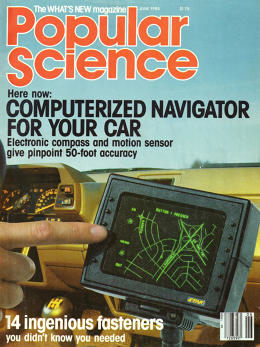
That’s not to say that Catalyst focused primarily on selling the promise of science fiction. The firms had engineers making real breakthroughs in the fields of optics, telecommunications, and navigation. In fact, one of the brightest stars of the Catalyst family gave birth to the entire electronic navigation industry. That firm was Etak, a company led by engineer and championship yacht navigator Stan Honey. In 1985, Etak released the world’s first in-car computer navigation system, the Etak Navigator.
At the time, the U.S. government was years away from fully deploying its network of GPS satellites and making them available for consumer devices. So Etak’s gadget used a combination of dead reckoning and map matching, with maps streamed digitally from cassette tape to pinpoint your location (and even provide directions) on a small screen. Bushnell envisioned the technology eventually pointing people to the nearest sushi restaurant–in 1985–which some in the press ridiculed at the time.
Even more impressive were Etak’s bleeding-edge digital mapmaking, storing, and processing techniques that spawned a suite of fundamental patents, and its portfolio of digitized maps themselves, all of which ultimately proved more valuable than a navigational device for consumers.
To Etak’s benefit, Catalyst’s shared office building encouraged the cross-pollination of ideas between companies. Alcorn, while working at Cumma, recalls being fascinated by the activities at Etak. During development, he snuck into nearby Atari’s coin-op division building with Etak engineers to show them the hit 1979 arcade title Asteroids. The game used a vector display that produced fluid animations with low-cost hardware. It’s little surprise, then, that Etak’s final on-screen representation of the car in its shipping product was a vector triangle nearly identical to the ship from Asteroids.
More than 30 years later, that bit of Atari-derived inspiration lives on: Many car navigation systems today still use a triangle with a slightly inverted base as a symbol for your car, and it comes directly from Asteroids.
Another Catatlyst success was Axlon, one of Bushnell’s favorites. It most notably created a line of successful electronic pets called Petsters and an interactive teddy named A.G. Bear.
Bushnell’s mind moved at a million miles per hour, and he created more companies than he realistically had time to deal with. It was a lot to manage, and he often found himself bouncing from one company to the next throughout the day, poking his head in to offer ideas. “He would be constantly talking to people all the time,” says Caloff. “It was one of his weaknesses, because he wouldn’t focus on anything for very long.”
ROBOT ATTACK
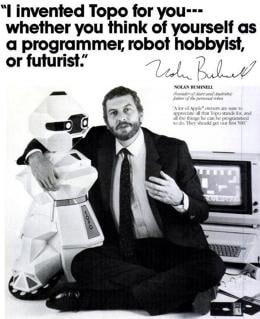
In 1977, George Lucas’s Star Wars ignited a frenzy for personal robot technology that lasted into the 1980s. Everybody wanted a C-3PO or an R2-D2 of their own. The Catalyst firm Androbot landed firmly in the center of that cultural movement, and Bushnell promised big things.
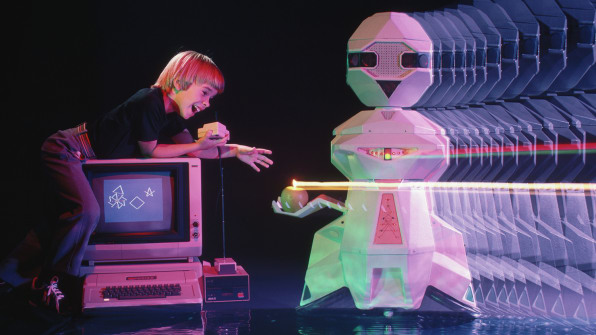
Androbot’s conceit was to create a personal robot butler called B.O.B.–short for Brains On Board–that would react to voice commands, fetch you things, and ideally do other simple household chores as well. The startup planned to do all this at a time when the typical microprocessor ran at under 2 MHz (and when 64KB of memory was cutting edge).
An Androbot demonstration at the Winter 1983 Consumer Electronics Show ramped up the public’s expectations of the young firm to unrealistic heights. Calof remembers Bushnell taking the stage, asking a B.O.B. prototype to fetch something. “The engineers had been up all night,” Calof recalls. “And it hadn’t worked, and hadn’t worked.” The audience was packed with press and potential investors who waited anxiously for the robot to make a move. “Sure enough, B.O.B. came out on stage, got Nolan a beer, and brought it out to him,” says Calof. “The place went absolutely nuts.”
But behind the scenes at Androbot, the firm’s engineers faced serious trouble. “The technology was giving us fits,” recalls Bushnell. They soon realized that their ambitions were exceeding reality. Even today, no firm is yet capable of creating a practical robotic butler–much less one that could be mass produced and sold to consumers, as Androbot planned to do.
Meanwhile, the firm had to bridge the revenue gap with a scaled-back product called Topo, which was bascially a glorified Logo turtle in the flesh. It hooked up to an Apple II computer, and it would move based on your commands. Otherwise, it did nothing, but Bushnell continued to stoke the robot hype to fever pitch.
Around that point in 1983, the press began to grow skeptical of Bushnell’s claims. A few reports even called him “the P.T. Barnum of Silicon Valley,” implying similarities between Bushnell with the 19th-century impresario who peddled sensational hoaxes and is widely credited with saying, “A sucker is born every minute.” Bushnell never shied away from the nickname, happy to be compared to a master showman.
When starting Catalyst, Bushnell had a rule that he would not put more than $300,000 of his own money into any one company. But he violated it with Androbot. “I fell in love with the product,” he explains. “The product was so fascinating, but the technology was so hard that I kept funding it and funding it.”
As Bushnell sunk more of his dwindling fortune into Androbot, he saw a light at the end of the tunnel. Merrill Lynch offered to underwrite an Androbot public stock offering. If Catalyst could sell Androbot, Bushnell could get his money back and carry on as usual. But the plan hit a huge snag in the summer of 1983. “A week or two before the auction was to take place, the whole high-tech market collapsed,” recalls Calof. Merrill Lynch became skittish, having been burned by two or three IPOs of what they called “pre-revenue companies” in the recent past. So they withdrew the IPO, and Bushnell was devastated. “I was left high and dry,” he recalls.
In 1984, Bushnell had another very bad year. While he was busy scurrying from one project to the next, one of his most promising business ventures, Pizza Time Theatre, ran into trouble. The chain had overextended itself, building too many franchise locations to be profitable. In March 1984, Pizza Time filed for bankruptcy and ended up being acquired by its principal competitor.
The Androbot IPO disaster combined with the bankruptcy of Pizza Time marked the beginning of the end of Catalyst. “The net effect was that the venture community lost faith in Nolan,” says Calof. “They basically said to us, ‘We’re not going to continue to fund these companies as you go forward, because we don’t believe in them anymore.’”
With no source of funds to keep the pre-revenue Catalyst firms running, many of Catalyst’s lesser businesses either sold at a loss or slowly petered out over the next three years.
“Catalyst was a company that made money when we had an exit,” says Bushnell, referring to the sale of its firms. “Up until then, it was cash-flow negative. Once Androbot sucked my cash, it was hard to keep it afloat.”
In 1986, Bushnell resigned all of his Catalyst firm chairmanships except one: The toy company Axlon, where he consolidated his business interests and personal attention. Before long, Odak left Catalyst, followed by Calof and Anderson. When the five-year lease for their “Rust Bucket” headquarters expired in 1986, Bushnell declined to renew. Catalyst was no more.
STILL NOLAN AFTER ALL THESE YEARS
In considering Bushnell’s legacy, it’s important to remember that Catalyst was an investment vehicle. As long as the firms sold to larger companies–even if they did not sell profitable products themselves–the ultimate business goal was achieved. So how well did Catalyst do on its investments?
According to Bushnell and Calof, seven out of the 14 major Catalyst firms ended up making money for their investors. Two broke even. And six ended up as losses. Some of the successes were impressive: Etak, Magnum Microwave, and ACTV later sold out to larger firms for handsome sums of money. Etak started an industry. Axlon went public and was later sold to Hasbro.
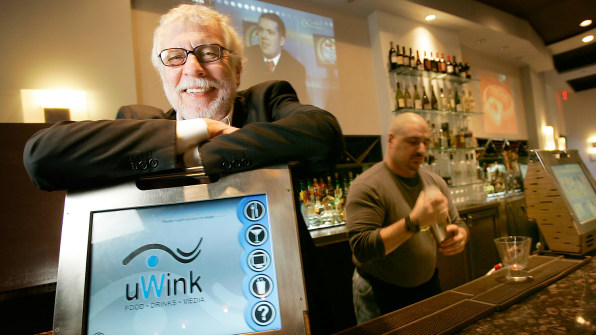
In the years since Catalyst shut down, Bushnell has been unrelentingly busy. He’s pushed Bushnell-brand home video games (Atari, 1988), computer/TV integration (Aaps, 1989), multimedia learning (Commodore, 1991), business-wide computer messaging and telephone integration (Octus, 1993), internet jukeboxes (PlayNet, 1997), casual games (uWink, 1999), networked gaming restaurants (uWink Bistro, 2006), and online education (BrainRush, 2015). Most recently, he’s dipped into mobile gaming and virtual reality.
Modern evaluations of Bushnell’s legacy often end up polarized, portraying him either as a legendary tech demigod or a washed-up huckster, with little room in between for the nuanced truth. The key insight into his personality is that he’s fundamentally restless. He explains his flitting from activity to activity by saying that he has “five-year ADD.” He tends to get bored and move on. Especially once things get settled: “I’ve always felt that once something is figured out and running, a lot of people can learn it. Why should I do it?”
As a result, Bushnell’s 45-year parade of companies is dizzying. His frequent startup hopping has left industry observers dazed–and maybe slightly jaded–about the potential for Bushnell to actually bring any of these technologies to life. After all, he dreams big, sells hard, and appears to believe his own hype.
There’s also the timing problem: “I think that being ahead of the game sometimes works and sometimes doesn’t,” Bushnell says. “I’m convinced that my success at Atari was because I was ahead of the game at the right time. Everything lined up, and it made it easy.”
With Atari, Bushnell’s timing was flawless not only just for the video game industry but also for Silicon Valley entrepreneurship in general—a vital force that he helped create. His relaxed management style rubbed off on employees who left Atari to form other companies, including a young engineer named Steve Jobs. (The oft-forgotten third Apple founder, Ronald Wayne, was also an Atari alum.)
Alcorn delights in crediting Bushnell with planting the seed for Apple’s culture at Atari. “When I worked at Apple, I was an Apple fellow,” he says. “In the interview process, they were very serious, asking, ‘Can you fit into our culture?’ That was a no-brainer for me, because the culture came out of Atari.”
What keeps Bushnell going, after experiencing decades of both stunning heights and painful setbacks? “It’s really the belief that no matter what happens, as long as you’ve got your health and your family is good, you can always make it again,” he says. “Money is actually not that important in the scale of things. It’s the projects.”
And then he adds, “I loved having the big house in Woodside, but I don’t miss it that much.”